Pressed flowers
The Girl with the Dragon TattooPressed flowers are both a collection and a communication system. Beautiful, rare, and apparently innocent, they preserve a vanished relationship in material form while converting Henrik Vanger's birthday into an annual encounter with uncertainty. Their repeated arrival makes the flowers the central object of The Case of the Pressed Flowers and one of the novel's clearest examples of how an ordinary keepsake can become evidence, threat, and testimony at once.
Form and Recurring Ritual
Pressed flowers arrive by post each year on the first day of November, mounted on water-colour paper in simple frames measuring six inches by eleven inches. The flowers are usually beautiful and rare, but the sender provides no message and no return address. The parcel is commonly posted in Stockholm, though other sendings have originated in London, Paris, Copenhagen, Madrid, Bonn, and Pensacola, Florida. The geographical variation expands the mystery without producing a usable trail: the sender or the plants could have moved through private collectors, friends, or mail-order exchanges anywhere in Europe or the Antipodes.
The object is therefore carefully made yet deliberately stripped of identifying information. Whoever mounts the flowers wears gloves, leaving no fingerprints on the frame or glass, and the frames could have been purchased in camera shops or stationery stores anywhere in the world. The flowers possess the outward form of a gift but the investigative behavior of a coded message. Their beauty invites attention, while their reproducibility and international circulation frustrate attribution.
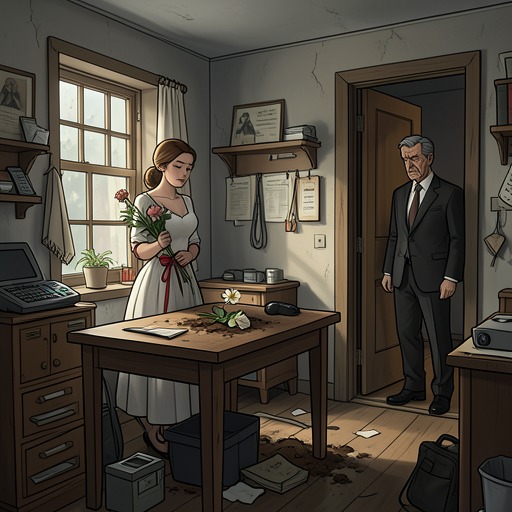
The ritual began when Harriet Vanger was eight. Because Henrik Vanger was born on November 1, Harriet gave him a framed pressed flower as a birthday present; she made the frame during the summer and saved it for his birthday. The first flower, a bluebell, arrived in 1958, followed in 1959 by a buttercup and in 1960 by a daisy. What began as a child's personal tradition continued after Harriet disappeared, but the identity of the giver changed from an affectionate certainty into an intolerable question.
Henrik Vanger's Collection and Grief
By his eighty-second birthday, Henrik Vanger had forty-three framed pressed flowers hanging above his desk: four rows of ten and a final row containing four. One place in the top row, the ninth position, remained empty; the newly arrived Desert Snow would be number forty-four. The precise arrangement transforms the wall into a calendar of absence. Each frame records a year, but the missing place also records the disappearance of Harriet Vanger, whose childhood gift had become inseparable from the wound she left behind.
The annual delivery is not merely a reminder of Harriet Vanger. To Henrik Vanger, it is directed torture, as though the murderer intends to make him relive the loss on the same date every year. He worries that Harriet Vanger may have been taken to reach him because it was well known that they shared a special relationship and that he regarded her as his own daughter. The pressed flower thus carries two opposed meanings: it is the most intimate surviving form of Harriet Vanger's affection, and it may be the instrument through which an unknown person keeps Henrik Vanger trapped in suspicion.
The collection also exposes the limits of forensic certainty. The flowers were scrutinized thirty years earlier by the National Forensic Laboratory, fingerprint experts, graphologists, criminal investigators, relatives, and friends. Yet the inquiry could not establish beyond doubt that a crime had occurred. The retired detective Gustaf Morell still regards the Case of the Pressed Flowers as his last unsolved and frustrating case, even after thousands of hours of thought. The object keeps the question alive without itself yielding a decisive answer.
From Keepsake to Investigative Clue
When Henrik Vanger explains the collection to Mikael Blomkvist, he restores the flowers to their original chronology and identifies their emotional force. The sequence from bluebell to buttercup to daisy establishes Harriet Vanger as the maker of the early frames and confirms that the practice was a repeated birthday custom rather than an isolated present. After the disappearance, however, the same form becomes an anonymous annual intervention. The evidence is powerful precisely because it preserves continuity while withholding the crucial change in authorship.
The pressed flowers also connect with the documentary materials surrounding Harriet Vanger's disappearance. Detective Inspector Gustaf Morell's typewritten report records the police response with unusual clarity and detail, while Harriet Vanger's date book supplies a different kind of archive: its calendar and sporadic diary entries preserve the surface of ordinary life, but its final page of telephone numbers conceals a mystery. Mikael Blomkvist later discovers that the numbers are references to chapters and verses in Harriet Vanger's Bible, specifically passages from Leviticus involving sexual acts, prostitution, mutilation, sorcery, and blood. The flowers are not themselves the Leviticus code, but they belong to the same larger economy of preserved objects in which personal things outlast speech and require interpretation.
The investigation repeatedly demonstrates that objects can be present without being understood. The first photograph in the 1966 accident photograph album is the last image of Harriet Vanger on Järnvägsgatan in Hedestad, where she watched the Children's Day parade. It had been overlooked because attention remained fixed on the bridge accident photographs. Similarly, a family photograph leads Mikael Blomkvist to realize that the woman previously identified as Cecilia Vanger was actually her sister Anita Vanger; the two women looked so alike that observers had treated them as one person because they had never appeared together in the same frame. In this pattern, the pressed flowers function as a material counterpart to photographs, diaries, and official reports: the evidence has been visible for years, but recognition depends on changing the question asked of it.
Material Traces, Violence, and Power
The book's other preserved objects clarify why pressed flowers matter beyond their decorative appearance. Martin Vanger's binders contain personal information about potential victims, and two faded Polaroid photographs record the sexual exploitation of a dark-haired girl whose face is turned away from the camera. Lisbeth Salander removes the photographs, burns the binders, and disposes of Martin Vanger's laptop in the water beneath a bridge. In contrast with the pressed flowers, which are carefully preserved and repeatedly displayed, these objects are destroyed or concealed because their material survival would extend the power of the abuser.
The distinction between preservation and destruction gives the flowers their ethical ambiguity. They preserve affection, but they also preserve uncertainty; they keep Henrik Vanger's grief active rather than allowing the past to settle. The photographs and computer carry proof of violence and financial crime, while the flowers carry a more elusive burden: not proof of a specific act, but proof that someone has maintained a relationship with Henrik Vanger across decades. Their meaning lies in recurrence, not in a single revelation.
That recurrence also links private memory with public consequence. The later investigation of Hans-Erik Wennerström depends on emails and copies of computer contents, including secret balance sheets involving bank assets in the Cayman Islands and two dozen other countries. Such digital evidence exposes a vast financial fraud because it can be assembled into a convincing burden of proof. The pressed flowers operate differently. They cannot by themselves establish who sent them or what happened to Harriet Vanger, yet their persistence gives the investigation its emotional and temporal shape.
Meaning and Narrative Significance
The flowers make time visible. One frame corresponds to one birthday, and the expanding sequence turns repetition into an archive. At the beginning, the ritual seems almost ceremonial: an elderly man receives a beautiful object, telephones Gustaf Morell, and identifies another entry in the series. Then the accumulated frames reveal the cost of ceremony. Henrik Vanger looks at the unknown flower, then at the wall, and unexpectedly begins to weep after almost forty years. The object breaks through the emotional control that has enabled him to live with an unresolved disappearance.
As a literary device, the pressed flower is a form of defamiliarization: something associated with childhood, botany, and domestic decoration becomes strange through repetition and context. Its fixed frame promises permanence, while the sender's changing postmarks introduce movement and concealment. Its delicate appearance contrasts with the coercive possibility behind the ritual. The flower is fragile, but the message it carries has survived forty years; the frame is small, but the unanswered question surrounding it reaches into police procedure, family history, memory, and fear.
The object ultimately resists a simple conversion into a solved clue. Harriet Vanger's disappearance is reconstructed through photographs, reports, family testimony, her date book, her Bible, and the account of her escape. The pressed flowers remain the most concentrated emblem of the case because they embody both what can be known and what cannot. They are gifts that may be threats, records that may be performances, and relics that continue to act upon the living. Their decisive significance lies in making absence recur: every November 1, the missing person returns as a flower, while the unresolved past arrives in the mail.